Our founding thesis
Radical Honesty.
Build for a world that can check the claim. Markets reward what they can see. When the measures are incomplete, businesses can optimise the claim while missing what matters—or profit from the gap.
We believe that gap will become harder to defend. Better measurement and AI could help people distinguish useful products from persuasive promises. Businesses that create real value should be ready to show it.
Food is where we want to start: help independent farms improve, make the results visible and give people with the means to act a practical way to fund the change.
Room to improve.
Disclose the evidence, the uncertainty and the money. Publish what fails as well as what works. Honesty means being accountable—not being perfect.
Why better information could change the economics
AI can make scrutiny easier, but can also spread misleading claims. Measurement, open methods and independent checks remain essential.
The economics of getting unstuck
A price is not
the whole cost.
A product can be profitable while leaving someone else to pay for depleted soil or polluted water. A farmer who improves those outcomes may face the opposite problem: the cost arrives now, while some of the benefits go to everyone.
That is a coordination problem worth solving. Farmers need demand; buyers need evidence; evidence needs funding. TNT brings patient capital and willing buyers together to make the first move possible—then tests whether repeat purchases can sustain the work.
01 / The first-mover problem
Waiting can make sense.
Together, we can change that.
Private payoff from adopting a new practice
Committed funding + buyer demand →
TNT’s first job: agree the budget, share transition risk and organise purchase commitments.
02 / A system that keeps learning
Make the next decision
better than the last.
The proposed learning & reinvestment cycle
Every useful lesson can reach the next farm.
The loop works only if results matter to farmers and buyers—and repeat orders cover the work.
Beyond doing less harm
Keep the capacity to produce.
Use fewer avoidable inputs. Reduce waste. Return suitable organic matter to the soil. Measure whether the farm’s productive capacity and finances improve together. Technology helps us learn faster; healthy living systems remain part of the asset.
The economic foundations
Prices can leave costs out. Externalities arise when an activity’s costs or benefits reach people outside the transaction. This can mean too much pollution or too little investment in knowledge. TNT’s narrower proposal is to coordinate some beneficiaries to fund useful work. IMF: externalities ↗
A stable outcome need not be the best one. Cooper and John show how complementary decisions can create coordination failures and inferior equilibria. Our first panel illustrates a possible participation threshold, not an estimated equilibrium. OECD also describes why dispersed beneficiaries can struggle to organise. Cooper & John ↗ · OECD: food-system reform ↗
Learning creates value others can use. IPCC’s review of innovation explains how costly early adoption, knowledge spillovers and first-mover disadvantages can hold change back. Learning can help, but its pace varies and limits remain. Applying this logic to TNT is our hypothesis. IPCC: innovation and transition ↗
Restoration can be part of the business. Paul Hawken argues for commerce that recognises ecological costs and rewards restoration. Circular-economy principles add a practical direction: prevent waste, keep resources useful and regenerate nature. These inform our design; TNT must still demonstrate farm economics and ecological outcomes separately. Hawken on restorative commerce ↗ · Circular-economy principles ↗
The missing information
What the label
doesn’t tell you.
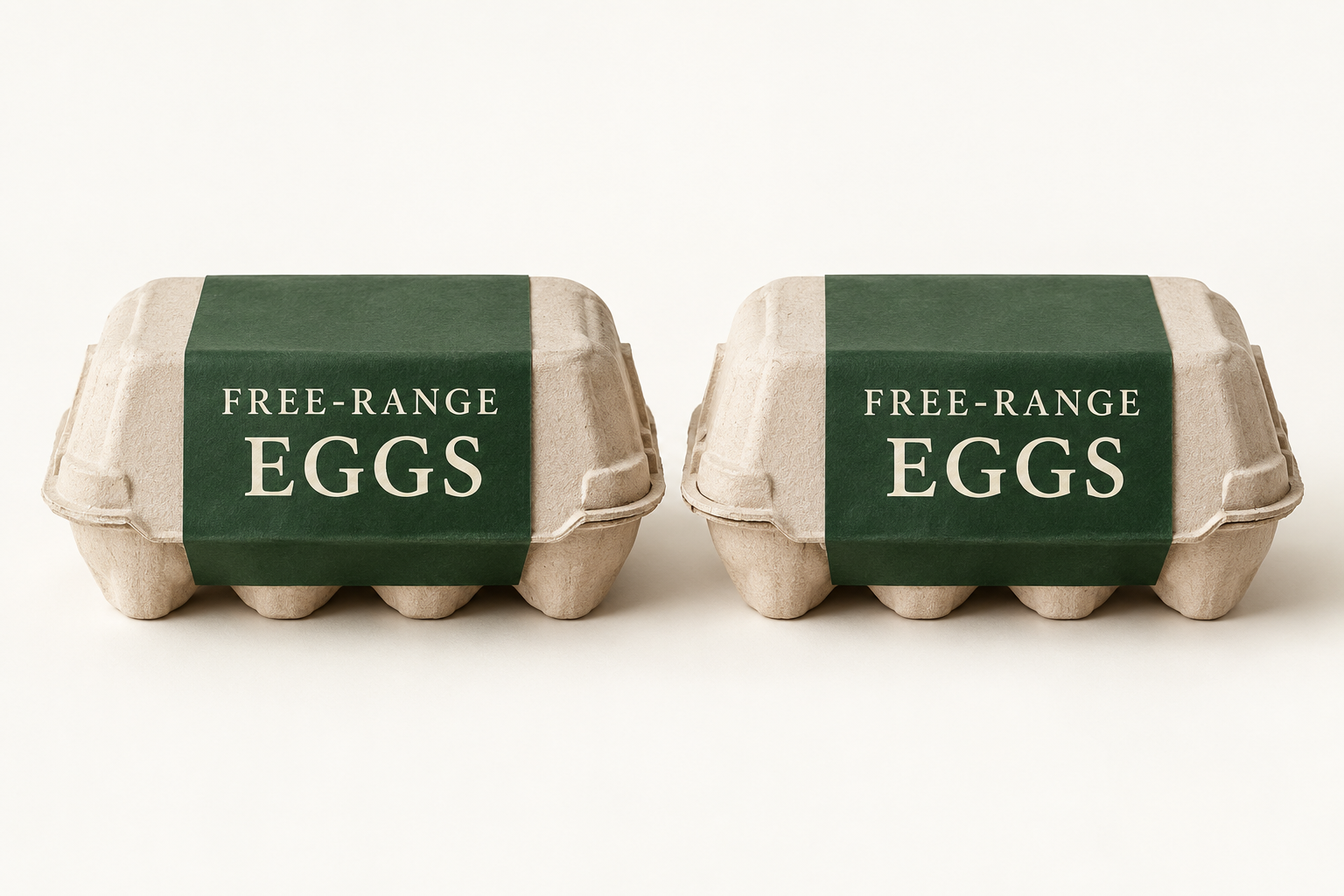
Two cartons can say “free-range” while hiding differences in sunlight exposure—and vitamin D₃ in the yolk. The label is the same. The food may not be.
A controlled four-week study
Sunlight changed
what was in the yolk.
Researchers fed 101 hens the same diet, varied their outdoor access, then measured vitamin D₃ in the yolks.
3–4×the vitamin D₃ concentration in yolks from the sunlight-exposed groups versus the indoor group.
Same feed. Different sunlight.
Indoor / outdoor choice
11.3µg per 100 g of dried yolkOutdoor hens
14.3µg per 100 g of dried yolkKühn et al. (2014), Germany. Read the study ↗
Study details and limitations
Values are vitamin D₃ concentrations in dried yolk, rather than amounts per egg. This short, seasonal experiment measured food composition; it did not test prices or human health outcomes. Funding independence was not verified from the accessible paper.
Farming choices can change food in ways labels miss. Measure the difference. Price the value. Reward the farmer.
Three further studies: farming, packaging and the grass-fed label
The economics of honesty
Capturing more value
is not creating more value.
A premium can reward a better product—or a stronger impression. These studies help separate changes in the food from changes in what we believe about it.
more than a promise.
Three real studies. Three lessons for where our food dollars go.
These studies measure composition and buyer valuations—not how much economic value goes to the household, farmer or distributor.
Reward the result. Make the premium accountable.
TNT would test promising practices, publish the findings and show what the farmer receives. The ambition is a premium that funds useful changes and shared knowledge—and gives buyers evidence to judge whether those changes are worth it.
What the research establishes—including the soil question
Soil is a research question, not an explanation we can assume. The 2026 study found no significant correlation between its measured soil parameters and beef fatty acids; forage composition was more informative. Retail samples lacked matching soil and forage data. It did not establish that poor soil caused certain grass-fed samples to perform less well.
Composition is only one step. These beef studies do not establish long-term human health benefits or a fair premium. TNT would need to assess serving-sized differences, implementation costs and outcomes—not turn one nutrient into a new blanket health claim.
Funding belongs in view. The 2024 cattle trial was funded by Greenacres Foundation. The 2026 study lists the Bionutrient Institute, a university grant, Applegate, Soilworks, philanthropic gifts and producer testing contributions; the authors declare no financial conflicts and report no funder influence on the results. These disclosures help readers assess the work; they do not by themselves invalidate it.
The economic inference is ours. Paying more for an unchanged benefit can shift surplus toward the seller. Misjudging quality can also misdirect demand. The studies illustrate why verification matters; they do not quantify those losses or prove deliberate deception.
More evidence: protein quality, soil and food processing
Protein quality matters, too.
Equal grams of protein can supply different amounts of digestible essential amino acids—the building blocks our bodies need from food. FAO’s framework assesses both amino-acid composition and digestibility. A protein number alone cannot describe the whole food or diet.
Soil is a promising part of the picture.
A small 2022 study comparing crops from nine pairs of U.S. farms found higher average levels of certain nutrients under regenerative management, alongside healthier soil measures. Results varied. This supports further testing; it does not establish that soil alone caused the differences.
How could we study protein—and how strong is the soil evidence?
Researchers have used stable-isotope tracers in adults eating eggs and chicken to estimate how much of their essential amino acids becomes available through digestion. That is a concrete way to investigate what people can use, beyond the amount printed on a pack. It does not establish superior protein quality in organic or regenerative products. Kashyap et al. (2018) ↗
The soil study was small and observational, with nearby farms matched by crop and soil type. It did not isolate soil effects, establish better protein digestibility or measure human health outcomes. The Dillon Family Foundation funded nutrient testing; two coauthors worked at a sampled ranch. These connections belong alongside the findings, which need independent replication.
Can a protein claim also create a misleading impression?
In a study published in 2024, 1,022 U.S. adults rated a protein-labelled cereal as healthier than its original counterpart. Many overlooked its higher sugar, sodium and calories at equal volume. The protein version also had more protein and fibre.
These were historical formulations shown in a 2018 survey. The study measured perceptions, not health outcomes. One useful nutrient does not settle the value of the whole food.
What about evidence from actually eating the food?
In a separate 2019 NIH randomized trial, 20 adults ate ultra-processed and unprocessed diets for two weeks each. The offered meals were designed to match calories and major nutrients, including protein. Participants could eat freely; on the ultra-processed diet they ate about 500 extra calories a day and gained weight.
This supports looking beyond a single nutrient claim. It does not establish that added protein is useless, that micronutrient scarcity caused the result, or that the same effects occur in children. Protein can be real and useful while the impression created around it is incomplete.
From conviction to a working business
Business Model
TNT is a hands-on transition business for viable independent farms. We turn promising research into a costed plan, organise funding and specialist support, and connect the resulting food to committed buyers. Farmers keep ownership and control.
A living company, built to compost its failures. The faster we turn failure into shared knowledge—instead of defending what isn’t working—the faster we can improve.
Patient capital starts it.
Repeat demand sustains it.
Patient capital funds setup and trials before sales can cover them. Early buyers fund food and learning through a disclosed premium. TNT would earn fees for planning, coordination and reporting; repeat orders must eventually cover delivery and continued improvement.
Who pays for the work—and what stays open
- Start with a buyer-backed cohort.
- Pool commitments around five farms, each with an agreed trial budget, payment schedule and plan for sharing losses. Work begins when funding is in place.
- Build a route to recurring revenue.
- Alongside households, test demand from food brands and institutional buyers willing to back specific improvements and purchase the resulting food. Product, volume, price and delivery terms must be agreed—not assumed.
- Charge for delivery. Share the learning.
- TNT’s disclosed fee pays for practical implementation and reporting. Safe research data, methods and findings remain reusable; no sponsor buys control over the answer.
These are proposed commercial arrangements. Buyer commitments, fees and capital terms have not yet been established.
Why we believe patient capital will come
We believe there are people with the means and the patience to back tangible improvements on working farms. Start with buyers who can fund early learning; aim to lower the cost of adoption over time.
Locally rooted farms may offer different exposure from infrastructure-heavy technology businesses, while still depending on energy, logistics and demand. Weather, execution and illiquidity remain real risks. Investment terms and returns are not established.
Discuss backing the first five ↗The price and our fee
Make every dollar visible.
Show what reaches the farm, what gets food to the buyer and what funds the transition—including TNT’s fee. The pilot must test whether repeat orders cover all three.
01
Where the money goes today.
USDA’s “food dollar” separates the farm share from processing, packaging, transport, storage, retail and food service.
All food combines purchases for home with food bought away from home, including restaurants.
Farm share11.8¢
Gross receipts for farm products.
Farm costs still have to be paid.
After the farm88.2¢
Processing ingredients into food products, packaging, transport, storage, retail and food service.
USDA calls the second part the “marketing share”. It includes making packaged foods and getting them to buyers—not only advertising.
National averages, not the split on every item. Directly imported finished foods are excluded. Shares describe spending, not profit. USDA figures ↗ · Definitions ↗
What we choose to buy helps determine which activities our money supports.
02
Show the whole TNT price—including the premium.
Before purchase, show the food cost, its route to the buyer and every use of the premium—including TNT’s fee.
The food price
Food & the route to you
- Farm product
- What the farm receives for the food.
- Preparation & packaging
- Any processing and materials used.
- Storage & delivery
- Handling, transport and fulfilment.
- Selling & payment costs
- Retail, payment and customer-acquisition charges.
The transition premium
The extra work you fund
- Farm transition
- Additional funding for agreed changes, with the farmer’s implementation costs explained.
- Testing & shared learning
- Samples, research and useful findings shared across the network.
- TNT’s fee
- What we receive for coordination and reporting. The fee is revenue before our costs.
An amount, a recipient and a purpose for every line. Show any retained margin, applicable tax and separate delivery charge before checkout. Then publish dated updates on how the premium was used, including changes and unspent funds.
The test is whether the farmer is better off after added costs and whether buyers value what their spending supports. A higher price alone is not success.
Explore the example price and premium ↗03
Build demand. Simplify what it pays for.
Pair the evidence with farmer-led social media, tastings and local outreach. Help buyers try the products, understand the premium and choose again.
As demand grows, test simpler products, shared collection and shorter routes. Keep the processing, packaging and technology that earn their place. Publish which costs fall—and whether farms and households benefit.
What could actually be saved?
The 88.2¢ post-farm share is not a measure of waste. Processing, storage, food safety and convenience can all add value. Local sourcing alone does not establish lower costs or a smaller footprint.
USDA’s comparison of 15 supply chains found that direct-market farmers took on extra processing, distribution or selling functions. Whether they benefited depended on prices, sales volumes and how efficiently they did that work. We would measure which costs disappear, which move and whether savings reach farms and buyers.
What existing food premiums tell us
1
Buyers already pay a premium.
A price premium is the extra a buyer pays compared with a conventional equivalent. USDA’s 2025 review describes organic retail premiums from under 10% to over 120%, depending on the product.
Whole Foods’ meat standards illustrate the market for verified farming claims. Organic prices give us a starting point for research; they do not predict what buyers will pay for a Third Nature product.
How to read a premium
Conventional price$1.00
With a 120% premium$2.20
Illustrative arithmetic, not a product price or forecast. A 120% premium means 2.2 times the original price.
USDA Organic Situation Report (2025) ↗ · Whole Foods meat standards ↗
Could healthier diets also reduce healthcare costs?
Diet-related illness creates costs far beyond the checkout. A 2019 NHLBI-funded study estimated about $50 billion a year in U.S. healthcare costs linked to poor diet and heart disease, stroke and type 2 diabetes.
In a separate NIH trial, participants ate about 500 more calories a day on an ultra-processed diet than on an unprocessed one. These findings support studying food quality; they do not establish health benefits from a particular farm or label.
Our longer-term hypothesis is that better diets could reduce some avoidable costs. Turning any savings into farm funding would require a deliberate mechanism: household or insurer savings do not automatically reach farmers.
The case for an early premium
The grocery bill is only
part of the equation.
Would someone pay 3× for a food product they can trace and understand? We believe some buyers will—for the food, the farmer and the knowledge their premium helps create. Their reference point may include wellness spending and money already set aside to help others.
Food for you. A contribution beyond you. One purchase can help fund a farmer’s transition and research others can use. The pilot will test whether that combination earns a premium—and repeat orders.
A deliberately high-spend example · Monthly USD · Editable assumptions, not market prices
Double the groceries. Simplify the rest.
Put more into groceries by choosing less takeout and fewer optional extras. Prescribed care stays unchanged in this short-term illustration.
A 3× price for selected products is the demand hypothesis. Both views below start with a 2× grocery budget.
An ambition to test, not a forecast. The long-term view assumes less need for treatment over time. The future medical budget is editable; TNT has not demonstrated this reduction.
| Monthly spending | Current budget | Short-term plan |
|---|---|---|
| GroceriesThe proposed budget doubles this line. | $ | $ |
| Takeout & convenience mealsMore meals made from those groceries. | $ | $ |
| Supplements & wellness extras | ||
| NMN | $ | $ |
| Greens powder | $ | $ |
| Electrolytes (e.g. LMNT) | $ | $ |
| Magnesium | $ | $ |
| Premium juices | $ | $ |
| Omega-3s | $ | $ |
| The medical budget in this example | ||
| Medical spendingToday’s example is a GLP-1 prescription. Its cost stays equal in this view. | $ | $ |
| Monthly total | ||
$400 more toward groceries. $320 less spent overall.
$720 less on takeout and extras covers the $400 grocery increase.
All amounts are hypothetical, not market prices or typical budgets. The short-term view models choices about optional purchases, with medical costs unchanged. Individual supplement needs vary; changes to prescribed treatment belong with a clinician.
TNT is a commercial purchase that helps fund the transition. Willingness to pay, nutritional benefits and future healthcare savings remain to be tested. Why we keep prescribed care separate: FDA medication information ↗
The product in your hands
The Experience
Meet the farm. Inspect the evidence. Follow your premium. Open the buyer demo ↗
The invitation on the label
Your next meal can help the next farm begin.
Buy a useful staple. Help one farm change and the next learn faster.
Illustrative packaging. Products would follow farm readiness.
Third Nature TheoryA better
A better
beginning.
Heirloom beans
Back an independent farm.
Help the next one begin.
$24 · includes an illustrative $12 premiumProduct, price and allocation are for testing.
The reason to choose it
“I can see what I’m helping to build.”
Meet the farms, inspect the premium and follow the work—without hiding what remains unproven.
Explore the full buyer page ↗Interactive concept only. No purchase or health-data connection is live.
A place in everyday life
Keep the jar.
Keep the connection.
Test whether a reusable jar keeps the farm visible and brings buyers back.
Packaging must justify its cost and footprint without consuming the farmer’s premium.
Third Nature TheoryA better
A better
beginning.
Keep the jar. Keep the connection.
 The farm story
Scan or tap ↗
The pantry collectionReusable jar concept · refills to be tested
Participate: local farms, feedback and optional research
Bring your judgment, feedback or expertise—on your terms.
Find your farmers.
See nearby farms, products and progress.
Explore local farms ↗Tell us what works.
Review taste, price and fit with real family life.
Explore feedback & reviews ↗Take part, on your terms.
Opt into testing or reporting with separate consent.
Explore ways to participate ↗Offer a useful idea.
Share expertise or an introduction a farmer chooses to use.
Offer expertise or an introduction ↗Your wellbeing. Your choice.
A proposed WHOOP connection could pair optional recovery trends with a food journal.
Partnership pending. No connection is live.
Health data and research participation are never required.
How we would reach buyers
Start with premium-food buyers and people who want their everyday spending to support change. Farmer-led social channels, local communities and clear labels explain what the premium funds. Test understanding, paid orders, repeat purchases and acquisition cost—not clicks alone.
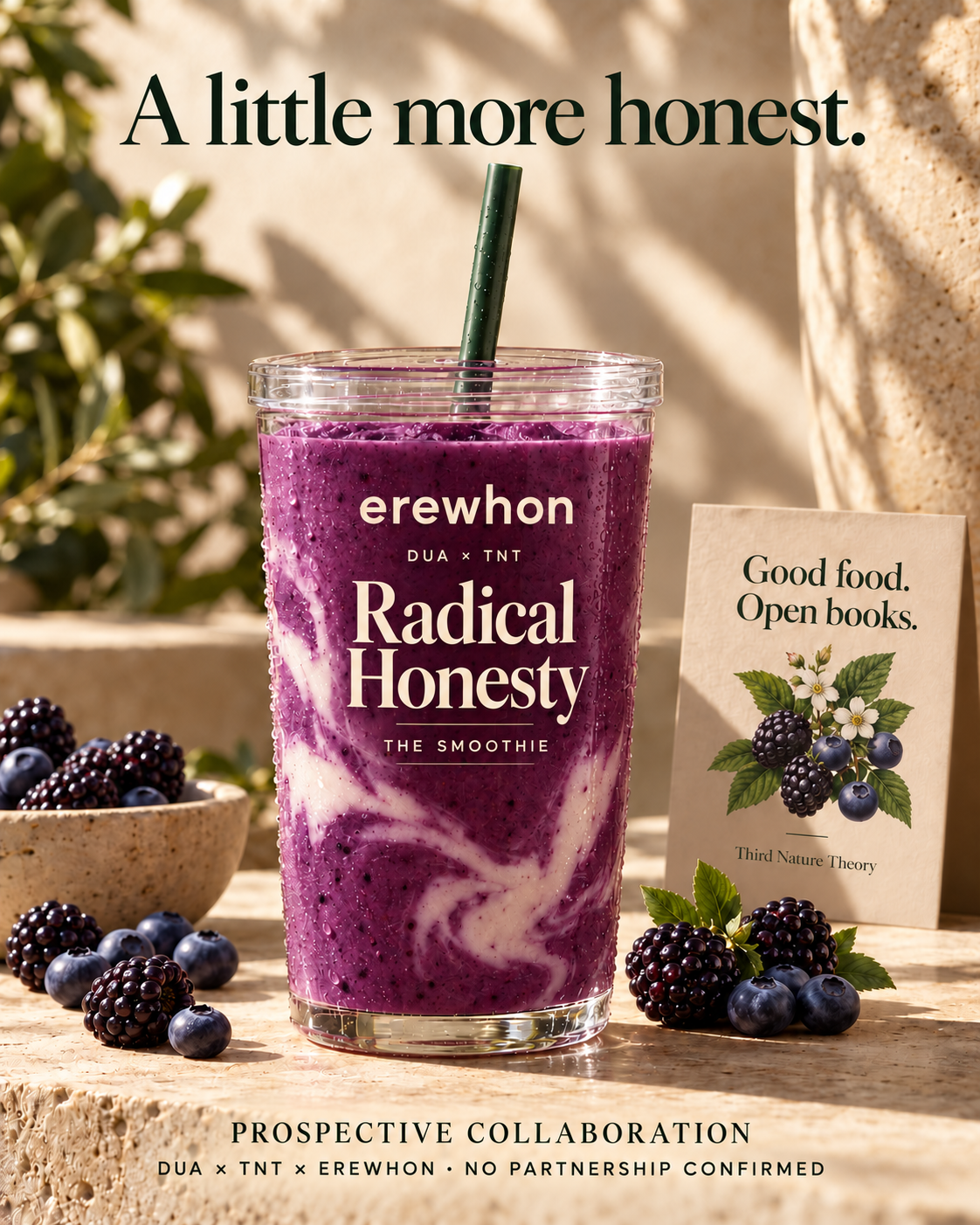
A future growth idea: Radical Optimism meets Radical Honesty
After the model works
Later, make a splash.
A flagship product could introduce more buyers to the farms and fund the next round of work. The smoothie is one possible idea—not a first-cohort goal.
Launch only with credible findings, reliable supply, agreed partnerships and a budget that leaves farms better off. Judge success by repeat purchases, not attention alone.
Companies already building the field
Good players. More hands needed.
Strong companies already finance farms, verify practices and measure food. We believe patient, hands-on transition work still needs more support. TNT adds coordination and buyer education; this is a market to grow together.
| Company | Primary business | What it already does well | Where TNT adds capacity |
|---|---|---|---|
| Mad Capital ↗ | Regenerative farm finance | Transition, operating, equipment and land loans for farms. | Consumer-funded pilots, shared food-quality research and demand before the return is certain. |
| Steward ↗ | Farm and food-business finance | Flexible capital and business support for producers. | A five-farm learning cohort, public evidence and a buyer-facing premium model. |
| Propagate ↗ | Agroforestry implementation | Design, financing, planting and market support for agroforestry. | Practice-agnostic trials that begin with the farm’s question and test food, cost and demand together. |
| Regenified ↗ | Regenerative verification | Standards, verification and a consumer-facing mark. | Exploratory trials and open results before deciding which outcomes deserve a market claim. |
| HowGood ↗ | Sustainability intelligence | Ingredient and product impact data for brands and retailers. | Direct coordination among named farms, researchers and buyers around food-quality questions. |
| Edacious ↗ | Food composition testing | Laboratory measurement and data connecting agriculture with nutrition. | Farm recruitment, transition execution, sampling, public interpretation and commercial demand. |
TNT could buy from, refer to or collaborate with these specialists. The opportunity is to grow the market together.
Comparison based on each company’s public materials as of September 2026. “TNT adds capacity” describes our proposed model, not a claim that another company never provides that function. The market is evolving and several companies span categories.
Why applying existing knowledge is a business
The bottleneck is often the work between a promising idea and a farm that can afford to use it: planning, technical support, measurement and a buyer.
Support already has a role. USDA’s Transition to Organic Partnership Program combines mentoring, technical assistance and market development. It demonstrates an implementation model; it does not establish willingness to pay for TNT. USDA TOPP ↗
Buyers can fund improvements together. Whole Foods reports joint investment with Stonyfield and UNFI in Organic Valley’s farm-level climate work. This is a precedent for shared funding—not a TNT partnership or proof of our proposed premium. Whole Foods: 2025 impact report ↗
TNT would earn its place by doing this coordination well and openly. Related perspective: Bill Gates on applying discovery ↗
A focused first test
Five farms.
One shared learning curve.
Each farm gets a tailored plan, expert support and a peer cohort. Together they compare results and improve the next decision.
Every lesson travels.
Trials, costs and results feed a shared body of knowledge. Ownership stays with each farmer.
Proposed network · Numbers represent farms, not stages.- 01
Understand
Record the farm’s starting point, goals and costs.
- 02
Plan
Cost the changes. Agree funding, purchase commitments, responsibilities and who carries each risk.
- 03
Try
Make changes and compare experience with the other farms.
- 04
Measure
Track what improves, what costs more and what does not work.
- 05
Sell & learn
Test repeat orders and farm earnings. Share useful findings—including reasons to change course.
Track whether other farmers follow the work, use a finding or apply. Later cohorts will test whether shared learning cuts transition time and cost.
Put research to work
on a working farm.
TNT reviews the evidence, designs practical trials, organises samples and brings in specialists—saving farmers time without replacing their judgement.
Why make peer learning part of the plan?
A randomized study in 200 Malawian villages found that reaching well-connected farmers helped new practices spread. Its results suggest many farmers needed more than one informed peer before adopting a practice. A review of farmer field schools also found learning gains in small programmes, but weak evidence and problems at scale.
These findings support testing a facilitated group model; they do not establish results for five U.S. farms. We would give farmers space to bring this week’s problem, compare practical attempts and seek specialist help. We would track problems resolved, time spent and changes adopted—not attendance alone.
Beaman et al., peer networks (2021) ↗ · Campbell field-school review (2014) ↗
Why competition and farmer independence matter
The wider value
Keep the market open.
Keep farms independent.
Farmers need choices in suppliers, processors, distributors and buyers. Viable alternatives improve bargaining power and reduce dependence on any one company.
USDA: market choices and bargaining power ↗ · OECD: the benefits of competition ↗
Help farmers weather change without selling their life’s work. Ownership, control and customer relationships stay with the farmer.
How independent farms complement food technology and AI
Read the evidence on concentration and farm choices
USDA’s research on markets with few buyers highlights the importance of alternatives, information and the cost of switching partners. It also finds that contracts and coordination can improve efficiency: concentration alone does not establish unfair pricing. Our focus is on practical choices and farm outcomes.
USDA reports that small family farms made up 86% of U.S. farms but 17% of production value in 2024. Large-scale family farms accounted for 5% of farms and 50% of production value. USDA also documents growing concentration in seeds, meatpacking and food retail.
OECD research on food systems explains how well-organised interests can obstruct reforms whose benefits are spread across society. It also cautions that claims of regulatory capture require evidence. Our argument is for wider access to information and economic opportunity, not an allegation against a particular business.
Buyer action can begin alongside policy reform. A five-farm pilot can test farm outcomes and shared learning; it cannot by itself resolve unequal political influence.
USDA farm structure data ↗ · USDA concentration report ↗ · OECD: interests and food-system reform ↗
Supporting detail
Three things
to inspect.
The evidence, the practical research plan and the rules that keep our findings accountable.
01 / Evidence and open questions
A claim should be open to inspection
What we know. What we need to prove.
Existing research supports questions worth asking. It does not establish results for TNT’s proposed farms. Filter the records to see the difference.
6 records shown
- Existing research · Expert framework
Protein quality goes beyond grams.
Amino-acid composition and digestibility both matter. A food’s overall value also depends on the rest of the diet.
Source, limits and next question
Basis: FAO’s 2013 protein-quality report; contributor affiliations are listed in the report.
Limit: it does not establish better protein quality in TNT products.
Next question: which measurements would help a buyer or farmer make a different decision?
Open the FAO report ↗ - Existing research · Controlled experiment
Sunlight changed egg-yolk vitamin D₃.
With the same feed, sunlight-exposed groups produced yolks with about 3–4× the vitamin D₃ concentration of the indoor group.
Source, limits and next question
Basis: Kühn et al. (2014). Funding independence was not verified from the accessible paper.
Limit: a short, seasonal experiment; no measured health or price benefit.
Next question: does the difference persist across farms, seasons and batches?
Open the egg study ↗ - Existing research · Preliminary comparison
Soil and food composition deserve study.
Paired farm comparisons found differences in some nutrients. They cannot isolate soil as the cause.
Source, limits and next question
Basis: Montgomery et al. (2022). Nutrient testing was supported by the Dillon Family Foundation; two coauthors worked at a sampled ranch.
Limit: small, observational comparisons; no human health outcomes.
Next question: can independent, repeated sampling reproduce useful differences?
Open the farm study ↗ - TNT hypothesis · Demand unproven
Buyers will pay—and return.
We think some buyers will fund transition and learning through a clearly explained premium.
Test and what would change our minds
Proposed test: completed purchases and repeat orders at a disclosed price, alongside customer-acquisition and fulfilment costs. Enquiries and demo clicks are not sales.
We would reconsider if: interest does not turn into repeat purchases at a price that covers the work.
Funding: a commercial TNT pilot; budget not finalised.
- TNT hypothesis · Farm benefit unproven
The farmer is better off after costs.
Transition support should improve the farm’s position without transferring ownership or disguising extra work.
Test and what would change our minds
Proposed test: a farm baseline and agreed budget; track net earnings, workload, funding received and transition costs.
We would reconsider if: extra income fails to cover additional costs and labour, or risk is simply shifted back to the farmer.
Funding: proposed buyer premiums and transition capital. Capital and loss-sharing terms are still to be agreed.
- TNT hypothesis · Wider usefulness unproven
The learning helps other farms.
Shared results and practical guidance could help farmers beyond the first five make decisions while the pilot is still running.
Test and what would change our minds
Proposed test: track repeat engagement from other farmers, requests for more information and examples they report of using a finding. Record applications as appetite for the programme; ask what information applicants found useful.
We would reconsider if: farmers show little sustained interest, or cannot describe a practical use for the findings. Reported use provides early evidence to investigate further.
Funding: commercial pilot documentation and outreach. Later cohorts will test whether shared learning reduces transition time and cost.
No TNT pilot results have been published here yet.
Results will need a named trial, dated samples, methods, funding and limitations. The research above is existing work by others.
See the proposed pilotRegister reviewed 25 September 2026. Corrections should preserve what changed and why. Question a claim or suggest a source.
02 / How the research would work
Start with the questions researchers need answered and the decisions farmers actually face.
- Choose a decision worth testing. Ask researchers and farmers which practice, outcome and comparison could change a real decision. Agree costs, methods and publication rights before starting.
- Establish a baseline; repeat the measurements. Link dated, traceable samples to farm practices and suitable lab methods. Account for season, variety and other differences that could explain a result.
- Test practical value. Track soil indicators, food composition, farm earnings and workload separately. A nutrient difference is not automatically a meaningful health benefit—or a viable business.
- Make the next trial smarter. Publish safe raw data and methods, including null results. Compare experience across farms, and keep, revise or stop practices on the evidence.
Food tests might examine amino acids, vitamins or fats. Human absorption and health outcomes require separate specialist studies, funding, consent and ethical review.
A practical precedent: Edacious and the Regenerative Organic Alliance announced a four-year programme to study nutrients and contaminants in certified products. That is a research plan, not a finding of superior health outcomes. Read the collaboration announcement ↗
Methods from the Bionutrient Institute and the Periodic Table of Food Initiative also merit exploration. These organisations are examples, not confirmed TNT partners.
Researcher? Tell us what evidence would be useful ↗03 / Publication, privacy and conflicts
- Make the work reusable. Release safe raw data, variable definitions, methods, analysis code where used, limitations and a dated correction record. No TNT datasets have been published yet.
- Protect participants. Keep identifiable farm finances, customer records and health data private. Agree consent and access before collection.
- Protect the answer. Disclose funding and commercial ties. Agree publication rights in advance; no partner may suppress an unfavourable result. Call research independent only when interested parties did not fund it.
- Welcome scrutiny. Assess criticism on its merits, disclose relevant conflicts—including ours—and correct errors publicly.
Why funding matters: a 2024 study of ESG-rating acquisitions found higher subsequent scores for existing clients of the parent credit-rating agencies. It is a concrete reason to make financial relationships visible—not to assume every funded finding is wrong. Read the study ↗
Methods informing the plan: preregistration · reusable data · research-data privacy.
Put what you have to work
Help build
the first five.
Bring a farm, capital, expertise or an introduction.
For farmersApply as a farm
A short introduction: what you produce, what you want to change and what would help.
For a useful introductionRecommend a friendSend a personal email invitation to a farmer or someone who would care about the idea.
Ask a question or offer help
Prepare a short enquiry, review it, then copy it or open it in your email app. Nothing is submitted or stored by this page.
Review your draft
Email: hello@thirdnaturetheory.org. Your email app sends the message only when you choose to send it. An enquiry is not enrolment in the pilot.